Showing posts with label nichelle strzepek. Show all posts

Friday, October 24, 2014

A classic book! A classic zombie film!

On this Friday, I wanted to share with you a couple of things:

A book review I wrote of Edward Stewart's "Ballerina." It is a classic tale of two young dancers pursuing stardom in the world of ballet. It was written decades ago but is timeless. Seriously, not much has changed in the dance world. We still have the same kinds of politics, the same kinds of people who enter the business, the same kinds of people who love the people who are in the business. And we have the same problems: injuries, jealousy, love and loss. If you're looking for something to put on your Kindle, check it out.


Here is my review from Dance Advantage. (DA is one of my very favorite websites for all things dance-related!) Thanks for posting, Nichelle! And the link for the Amazon purchase.

From one classic to another...Zombie Ballet! So you're thinking, what could Leigh do with zombie ballet now? She's done ArtNight Pasadena several times, each year slightly different from the last so what could this year bring?

How about a short film? Last spring, when I was shooting the dance for my own purposes (I wanted a nice copy of it with great lighting and photography), I decided to write a short story around it and make it a little more interesting than merely a dance. So I wrote"The Dead Shoes," a short film about a young dancer who goes to a ballet class on Halloween in an empty studio - or is it empty?

It was a lot of fun to shoot and it combined all the things I'd studied in my life: filmmaking, writing and dance. We premiered it on October 10 at ArtNight Pasadena at ARC Pasadena and the crowd loved it! Twice!

Here it is, for your Halloween enjoyment:


Thursday, May 15, 2014

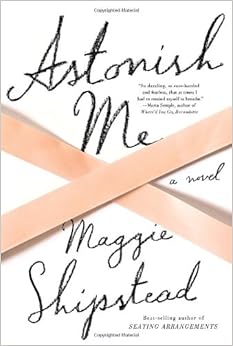
Book review: Astonish Me by Maggie Shipstead


Full disclosure: Random House provided a free advance copy of the novel for review.

Fuller disclosure: I am a published novelist and filmmaker as well as a ballet instructor.

Fullest disclosure: I have always wanted to write a novel set in the world of ballet.

There are so many movies and television shows that appeal to lovers of dance. You might be a fan of the ballroom competition in “Dancing With the Stars” or the more contemporary “So You Think You Can Dance.” Perhaps you enjoyed the “Step Up” series of movies or the classic musicals starring Gene Kelly or Fred Astaire and Ginger Rogers. These are all wonderful showcases for dance and the dancers in them are terrific and talented.

But for lovers of ballet, there really is only one definitive movie: “The Turning Point,” a 1977 film starring Shirley MacLaine and Anne Bancroft and introducing the inimitable Mikhail Baryshnikov to the wider world. It was brilliant and beautiful and heartbreaking, soapy and sappy and sentimental, and it felt genuine and honest to the world of ballet.

Maggie Shipstead’s novel, “Astonish Me,” is the literary equivalent of that movie. And just as the right cast can multi-dimensionalize characters which might be considered stereotypical (as in “The Turning Point” with the Academy Award winning actors Bancroft and MacLaine), so too does exceptional prose bring to life a story that might be too well-known to be exciting.

That story, of course, is Mikhail Baryshnikov’s defection from the Soviet Union and his establishment in the United States as one of the best male dancers in ballet history. In this case, it is Arslan Rusakov who defects in 1975 with the help of a very young corps de ballet member, Joan Joyce. She falls in love with him, as most women would, but is quickly disillusioned by his unwillingness to be faithful to her. When she realizes her talent as a dancer isn’t nearly what it needs to be in order to be a prima or even a soloist, she chooses to marry and have a family, moving far away from the bright lights of New York City to raise her son, Harry and teach others.

Meanwhile, her former roommate Elaine Costas is a rising star in the company, as well as the secret muse and lover of Mr. K, a thinly-disguised Mr. B (Balanchine). She gives up the possibility of family and children to stay with him as he grows older and to dedicate her life to the company.

Through the years, we watch Joan’s son Harry blossom into a stunning dancer, one who initially took up ballet only to impress Chloe, a neighbor he has a crush on and whom Joan has taken under her wing. Joan recognizes herself in Chloe, a girl who isn’t perfect but has many gifts (like so many real-life dancers). We also see Arslan through his marriage to Ludmilla, another defector from the Soviet Union, and his continued rise in the American dance world.

All the storylines come to a startling conclusion in a dark theater in New York City nearly 30 years after Joan and Arslan’s story began. No spoilers from me, but the ending is not a perfectly happy one.  It is, however, a realistic one.

One of the most challenging aspects of a novel that deals with a very specific dance idiom like ballet is that it runs the risk of appearing rarefied and incomprehensible to others who are not privy to its inner workings. In some books, if you don’t know dance terminology or the details of the environment in which these characters live, you will feel lost. Not so with Shipstead’s novel.  For the balletomane, it is filled with thinly-veiled yet recognizable characters from the real dance world. For the technician and student, it is filled with correct dance vocabulary and believable studio and stage situations. For the romantic, it is filled with love stories and heartbreak. But you need not know anything about dance to enjoy this book. Shipstead has crafted such a beautiful story – a page-turning, fast-paced read – that will appeal to a broad variety of readers.

A few of my favorite lines:

Elaine, on ballet’s place in her life: “Love for ballet is necessary to survive it, but she doesn’t know if she survives because she loves to dance or if the love comes from a need to survive.” (p. 72)

Campbell Hodges, the company manager, to Joan: “You can’t be weak in the ballet or it’ll crush you.” (p. 129)

Young Harry, frustrated by his unrequited love for Chloe: “Girls always seem to be straining and crying for some invisible thing they recognize and want but that seems completely obscure to him. They seem to want to have something to want, as though wanting was an end in itself.” (p. 162)

(This review was cross-posted at Dance Advantage.  Check out the site here for more dance resources.)

Monday, September 23, 2013

Is it Nutcracker time again?

Doesn't it seem like we just danced to Waltz of the Flowers?  No?  Seems like it to me!  A year has passed so swiftly....!

As lots of studios and schools tackle the annual winter show, whether it's Nutcracker or something else entirely, both dancers and choreographers struggle with the steps.  Teachers and choreographers usually have little time to teach the material to dancers, who in turn must be able to process and memorize in an instant.  More follows from week to week.  In the case of smaller schools with smaller bodies of dancers, there is the added pressure of multiple roles within a show.  Most dancers do not have the luxury of spending several months learning one piece and most choreographers do not have the luxury of a full-time cast.

It can be frustrating on both sides but I want to offer some tips to students and teachers at this time of the year, just to ease the tension that inevitably builds as you get closer to performance.

Dancers:
1. Attend technique classes regularly.  Stay on top of your pointe work, your pirouettes, your allegro.  This is not the time to skimp on classes.  Confidence comes from knowing you are technically in control.  Also, consistent class attendance gives you the opportunity to practice picking up choreography and learning spatial awareness for the stage.

2. Be focused during rehearsals.  When a section is being taught to another group, do not check your iPhone.  Do not chat with your friends.  Do not rest.  Pay attention to what is being taught because you may be asked to do it, repeat it, reverse it, etc.

3. Let go of the ego.  Some of the dancers in your group will be better than you, faster than you, pick things up more quickly than you.  Get over it.  You were chosen for the piece too.  You all have a reason for being there. But if you get yourself worked up over your skills or whatever, you will lose the thread of the choreography.  Instead, GET TO CLASS!

4. Be prepared. This means get your shoes and tights ordered in advance, homework done, schedule cleared.  If you know you cannot make a rehearsal, tell the choreographer well in advance!  Do not rely on a friend to tell him or her you won't be there.  Better yet: don't miss rehearsal.

5. Don't talk back in rehearsal.  Having a problem picking up a step? Work on it at home or in class.  Talk to the choreographer outside of rehearsal only when you absolutely cannot do something.  DO NOT challenge the choreographer during rehearsal.  It is rude and disrespectful- and time-consuming.  And it will guarantee you will be replaced.

Choreographers:
1. Manage your expectations.  You will rarely, if ever, see your work performed exactly the way you imagine it in your head.  Get over it.  Do the best with what you have and understand that the essence of the piece, its meaning and subtext, can still be achieved even if the steps are not what you had in mind.

2. Simplify whenever possible.  While it's tempting to give dancers challenging material, if they are not pros, they may freeze up when they get on stage.

3. Encourage your dancers. Let them know when they are doing something well so they will not always hear negativity from you.  You want them to enjoy themselves in rehearsal so they will learn to project it on stage.

4. Videotape rehearsals and send to the dancers for between-rehearsal practice.  Not only does it give you a record of what you did from week to week, but it also can help them remember what they need to work on. Also, since they are in the middle of the piece, they may not understand how it all fits together. Looking at it on video gives them a wider perspective.

On Nichelle's Dance Advantage website, David Alonzo Jones writes about how he helps his students pick up choreography in class.  I think both dancers and teachers can benefit from reading this.  Thanks, Nichelle!

Happy dancing!  Happy Nutcracker~


Thursday, May 23, 2013

Is it "Beginner" or "Basic" or "Adult" or "All of the Above"? The Trouble With Labeling Adult Ballet Classes

**Please note, I added to this post below with another great response from dancer/teacher/blogger Carla Escoda.  

Not long ago, Jamie Benson (instructor, performer, and choreographer - and blogger!) wrote a great article for Dance Advantage about Recreational Dancing for adults.  Specifically, the piece was for teachers of adult students.  It was terrific and naturally, I posted a link to it for all of my own students to see.

But what was equally interesting to me were the comments on the article.  One adult student posted about the changing makeup of the Beginner Ballet class she was taking.  She was frustrated that a new teacher had made it difficult for her to keep up and that there were advanced students taking the class, which she believed led to distractions for brand new students.

I really wanted to respond to this comment since this is an on-going issue for most teachers of drop-in classes. Unlike a college course or an intensive which has an end date, drop-in classes require constant monitoring of students so they can be beneficial to all who attend. I couldn't put into words what I wanted to say but fortunately, Jamie responded with a terrific answer, which I asked him if he would allow me to quote (thank you, Jamie!). You can go to the original article and scroll down through the comments for more but I wanted to highlight his reply for you:

"I applaud your venture into dance & hope that you take another step or two (both physically & metaphorically) before giving up on the notorious "beginner" / mixed level adult ballet class. You're bringing light to a real issue. Just today, I attended a mixed level ballet class where the instructor sort of fritzed out due to the varied levels of the participating students (horrific really). 

First of all, THEY the instructors should be "reading the room" so to speak & offering less experienced dancers slight modifications to the combinations. Even though they need to keep the class moving they also need to be throwing out very descriptive language for even simpler movements. The more experienced dancer needs to hear that too in order to be more expressive and refined in every moment. I would go directly to the instructor and/or staff of the studio and make suggestions of this nature. The studio is there to accommodate you as a student & the structure of these types of adult classes need to continually adapt to the students that want to take them. Because they're ALL different. 

As someone who sort of prides himself on teaching adults of all shapes, ages, & backgrounds, I can attest to that truth. Yes, some self sufficiency is important on the student's part as well. Take dance into your daily life a bit more. Bone up a little with very basic 10 minute instructional videos on Youtube. Familiarize yourself with more basic ballet content & don't forget to ask questions while taking class. Most importantly, don't be too hard on yourself - sounds easy but... Carla, who is awesome, is absolutely right. Whether it's because of time away from dance, an injury or just a need to focus on technique & not complicated sequencing, more seasoned dancers need to get back to basics too. It can be an opportunity for everyone involved. Hell I found myself quietly helping those that had not danced before during the class I took today. They may be your best ally."

Please note Jamie's suggestion that students also be "self-sufficient," that they do some legwork themselves (no dance pun intended!) to understand what ballet is about.  I often tell my new students to look at my instructional YouTube videos and go through my blog posts to get familiar with terminology and class procedure.  If you've never been in a ballet class, there are certain things we do in every class that, if you have some advance knowledge, you will have one less reason to be anxious!

So whether the class is called "Beginner Ballet" or "Adult Ballet" or in the case of my classes, "Advanced Beginner" and "Basic," please understand that there will always be a variety of students in there, from the complete newbie to the advanced dancer, and they are all there for very different reasons.  We want to make it a fun and educational experience for everyone so it helps all teachers if you keep an open mind and remain flexible too (another dance pun!). Happy dancing~

**Addendum: Carla Escoda, whom Jamie refers to in this comment, previously replied to the same woman who asked about her Beginning Ballet class.  This is Carla's fantastic and focused response (thank you, Carla!):

"There’s a big difference between ballet classes for adults that are labeled BEGINNER and ABSOLUTE BEGINNER – the former are almost always mixed-level, that’s just the way the economics of the studio business work out. Hopefully, teachers of mixed-level classes offer modifications to make the combinations easier or harder, but when they don’t, students have to figure it out themselves. To make a combination easier, you can turn pirouettes into balances, or do 4 slow ronds de jambes in place of 8 quick ones, or keep the arms in a low 5th position instead of doing a more involved port de bras… that kind of thing. 

Advanced dancers usually don’t show up to ABSOLUTE BEGINNER classes but they will sometimes come to mixed-level BEGINNER classes because they want to focus on some specific aspect of technique without having to deal with the complicated choreography in a more advanced class – it’s a good habit for them to occasionally take class at a lower level. And it’s valuable for the beginning students to have good visual role models – you can learn so much from watching someone whose technique is more proficient than yours. No matter how good a teacher is, he/she can only give you ONE view of what a step looks like!"

[As always, thanks to Nichelle at Dance Advantage for hosting Jamie (and others!) and for providing really helpful dance resources for teachers and students!]

Wednesday, April 3, 2013

10 Tips for Adult Newbies Who Aren't New to Ballet by Kathy Lu

Kathy Lu has a wonderful guest post at Dance Advantage which is one of my very favorite dance blogs. She discusses returning to ballet as an adult and having to absorb some harsh realities which she shares with other adults in a very amusing and honest way.

So many of my students are in this category. It can be a challenge as a teacher when someone comes back after years away and expects to be as good as they used to be. You know your body has changed in some measureable ways but there are some things you forget about when you're not dancing consistently (like using your inner thighs and pulling up your arches).

I think Kathy's list is tremendously valuable for teachers and for students themselves. If you are walking into my class after being gone for a while, I hope you will find some wisdom and encouragement in this list. If you're a teacher of adult students, it's a great reminder list of what is going through someone's head when they put their bodies and souls in our hands.

Thank you, Kathy, and thank you Nichelle, for letting me share this link with my students and friends.

Beginning Again in Ballet

Happy dancing~

Sunday, January 13, 2013

Dance blog contest!

Nichelle at Dance Advantage is hosting a blog contest and I'm entering for the very first time! 

Among the categories is Teacher Talk, which I think is the category my blog best fits.  It's for blogs that address topics from teacher to student or teacher to teacher.  As my readers, you know I like to talk about pirouette technique or classroom etiquette or my pet peeves as a teacher.

So if you agree that my blog is a pretty cool one and you get some use out of it, I hope you'll jot down a comment below.  The blogs with the most comments will be finalists in Nichelle's contest. The winner will be named Editor's Choice! I'd love to be a finalist - there are some amazing dance blogs out there.

Reminder: please don't comment on Nichelle's blog - instead, please post your comment here!  Thank you for your support.

Tuesday, July 24, 2012

Why does dance matter?

This week, bloggers and dancers all over are responding to the question, Why Dance Matters, which was first posed by Nichelle at Dance Advantage (one of my fave blogs if you don't already know that!).

I've been checking out everyone's inspiring, thought-provoking, funny and humble posts at the Facebook page (link here).  Please consider adding your own personal voice to the page and share with dancers and dance lovers everywhere your reason why dance matters to you.

There is the metaphysical: one of the things I see referenced often is that dance is a reflection of a person's soul.  It allows the individual to expose their own inner being to the world at large through their physical movement.  I also love the comments about how dance saved some of them when their darkest hour was at hand.  Some are parents writing about the necessity of dance in their children's lives to boost their self-esteem, to help them deal with tough times and tragedies, or to simply express their own joy of life through creative movement.

And there is the physical: Endorphins are released from your brain every time you move, making you feel good, soothing your aches and pains. Dance can help keep your muscles toned and shapely, so you look good as well. It can help control diabetes and weight gain. And dancing to music helps brains develop too, especially those of young people. For older students, dance is good for their bones and is a form of exercise that is easier on their joints than something like running, not to mention the memorization of combinations helps delay senility.

Lots of good stuff in dance.  So why do I think dance matters in this day and age? When there are so many other things that take up our time and focus, dance is but a small blip. As my husband likes to remind me, dancers are few in this world and of them, ballet dancers even fewer.  Although my life revolves around it, why should others?

Dance is both bigger and smaller than you.  Dance transcends age and ability. It can be a stage performance by ABT or it can be your child in your backyard.  It is the creative expression of things that are far beyond your comprehension and it is also a small story you want to tell your loved ones. When I dance, I know that I am a part of something that has its roots in history and when I teach, I am honored to be passing on that history.I love that dance changes with each of us and yet I love that it spans continents without change. 

Yes, dance has something to offer all of us but most of all, we have something to offer dance.  Every one of us has a gift that can enhance the art form of dance.  There is beauty in every one of us who dances.

Friday, April 20, 2012

New links of note and a quote!

First the links:

One of my wonderful - and wonderfully creative - students has a blog called The Spinning Dancer where she likes to write about dance.  Most of the time, she comments on ballroom dance, which is her specialty, but this post is about ballet class.  I think you will enjoy it!

And here is a blog that's new to me, Grown-ups at the Barre (what a great name for a blog!).  Thanks to Nichelle at Dance Advantage for sharing the link.  Lots of great resources and insight for the adult dancer.  Who knew there were so many aficionados out there?  I love it!

And now, the quote...from the illustrious Allegra Kent, on teaching (from Dance Teacher Magazine):

"I think everyone's teaching changes as time goes on. I was definitely a little wilder when I first started--very wild. I've calmed down a bit, but when I teach on Friday morning at 10 am, these students are exhausted, so I need to give them a lot of energy to wake them up. I've learned that pure movement and a lot of wit are the best ways to engage them.

Learning about my students outside of the classroom helps me understand them. I have them write me poems and through this, I've discovered wonderful things about them that I would have never known from just seeing them bend their knees."


Talking with one of my students recently has made me think about the relationship between a teacher and her students. I'm formulating a post on this...stay tuned for a bit of philosophy.  Happy dancing!

Friday, January 27, 2012

Why do a floor barre?

About two months ago, one of my students whom I work with en pointe became injured.  She couldn't releve or do a traditional ballet class but was reluctant to merely rest until she'd healed.  She (and I) didn't want to lose her strength or flexibility that comes from consistent technique class.  So I suggested we do floor barre for a while. Since I wasn't entirely sure how to construct one, I reviewed notes I'd gotten from Nichelle Strzepek of Dance Advantage (one of my very favorite dance web sites) and started with that. Using some of Nichelle's guidelines and suggested exercises, I built my own floor barre class.

And then....I became addicted to it!  Seriously.  Well, maybe not quite so seriously.  Part of it was the novelty of a new type of class (which always fires up my creative energy) but another part was how engaged certain muscles were.  For instance, I talk a LOT about the importance of inner thigh work, why we must engage the tops of the legs for turnout and lift, for pirouettes and adagio and more.  But it's not always easy to identify those incredibly necessary muscles. With a floor barre, you cannot cheat very easily.  And without the distraction of epaulement and port de bras, there is nothing else to focus on but using your abdominal muscles and inner thighs to rotate and lift the legs.  Genius!

A proper floor barre will mimic much of the same exercises we do in a traditional class.  But it will also include core work: situps and crunches to work the obliques, pushups or yoga-type positions for the upper body (which almost never gets worked in ballet class).  My class also incorporates lots of static stretching for increased flexibility.

Perhaps the best part of the class is the end!  When you leave, you really do feel a sense of euphoria because nearly every part of your body has been engaged at some point. You've also, hopefully, pushed yourself a little beyond what you normally might do.  There's something about the anonymity of laying on your back with no one else to see you and no mirror in which to see yourself that allows you to push farther.  Maybe it's the lack of pretense, the lack of performance involved, that lets you simply work the muscles properly and get in touch with your center.

A floor barre will never take the place of a traditional class but it's of great benefit to just about every type of student and I heartily recommend it.  For anyone interested in trying class with me, I teach a stretch/floor barre on Thursdays from 5:30-6:30PM at Le Studio.  I'll be there, for sure, even if you don't show up!  That's how addicted I am!

Cheers, happy dancing and stretching and super special thanks to Nichelle!