Showing posts with label arabesque. Show all posts

Thursday, December 24, 2020

Shoulders forward & the importance of incidental activity

As we close out the year (good riddance, 2020!), I want to offer a final technique tip and an observation.

First the tip:

Keep your shoulders in front of your hips during pirouettes, penchees, promenades, jumps, and generally speaking, during pointe work.

What do I mean?

Grab a mirror and observe your alignment in profile when you stand up straight. Where are your shoulders in relation to your hips: behind your hips, centered over them, or in front of them? Most likely they are centered over them. If you have a tendency to slouch, your shoulders may be behind your hips.

When we rise onto demi-pointe or pointe, we often pull our shoulders back or allow them to droop; this includes turns and pushing off the floor for jumps. 

Now, still in profile, lift your ribcage up out of your waist and gently move your torso forward. Note that your hips are still over your heels and your pelvis is in a neutral position, nothing is tucked or gripped. This is where you want to be when you prepare for a pirouette or take an arabesque into a penchee or even when you push up off the ground for a jump.

What do I not mean?

Don't roll your shoulders or hike them up to your ears. Also, try not to hyperextend your lower back and avoid splaying the ribs.

(This image was made by Loadmaster (David R. Tribble) CC BY-SA 3.0 via Wikimedia Commons)

Please note the dancer's shoulder placement in the arabesque to the left.


(Ron Kroon / Anefo, CC0, via Wikimedia Commons)

Please note the placement of the shoulders in this grand jete to the right.

What will this do for you?

For one thing, it helps stabilize you, balancing your natural tendency to fall back as you go up. And for another it will help you engage your back muscles and keep you lifted and not sinking.


And now...an observation about the influence of the pandemic on our bodies (as if we didn't need to know about yet another negative effect!):

When incidental activity is diminished, our baseline of movement is affected. 

What do I mean by "incidental activity?" 

That's the walking from our cars to the grocery store, the running into the bank to deposit a check, the filling up of our gas tanks, the casual jostle walking among crowds at an event or in a school or a theater or on public transportation...all these things contribute to the baseline of our movement including balance. 

Remember before the pandemic when you used to walk around with a purse or shoulder bag or backpack? You would have to balance that on your shoulder and move it with you when you moved, from side to side or up and down. That's movement. That's balance. That's activity. When you're not doing that as frequently, you have far fewer chances to practice.

In your homes, it's a quick walk to the restroom or to get some water but at the dance studio, maybe it was down the hall. That's extra movement, extra walking you did.

In our Zoom environments, we sit to talk to people because if we stand, we are at waist level with our cameras; if we move around, our microphones won't pick up our voices and our auto focus gets blurry. But these are all things we used to do when we talked to people in real life.

What is the result? And how does that affect dancing?

One thing we lose is muscle tone: all that sitting doesn't give our quads and calves and hamstrings opportunities to strengthen, nor does our core engage as frequently. When we don't walk as much, we lose our stamina and get out of breath more quickly. And when we don't have to adjust around people, we don't have chances to find our balance.

For our dancing, this means we must take extra steps in class. Even if you were taking the same number of classes as you were before, likely you are not working as hard or have the ability to do things like jumps or allegro. Our balance might not be as good because we aren't calling upon it as often. 

What can we do?

In class, we can take the time to work on balance OFF the barre when we need to engage our cores and stabilize ourselves. We can build calf and ankle strength through extra exercises. We can also do small jumps in sneakers if we don't have the correct flooring.

Outside of class, we can walk a little bit more (an extra turn around the block with the dog), maybe carry something with us so we build some upper body strength and work on balance. Hiking or carefully navigating uneven surfaces can also help us balance.


Thursday, June 28, 2018

Stackables!

It sounds like a new snack, doesn't it?

Have some Stackables with your Lunchables!

Actually, I'm talking about creating a stackable alignment in your body as a way to "get over your leg."

When I talk to my beginner students, especially, about pique and releve, I often tell them they need to get over their legs. In other words, they need to get their torso over their hips and pull up so they can fully point their legs and feet and arrive at the highest releve possible. We never want to sink back into our knees or try to turn or balance on a low releve.

But for many dancers, it's hard to imagine how they get to that place. They end up leaving their hips and derrieres behind them and they never get the highest peak possible.

So add one more "stacking" item as you push yourself to arrive on your leg: your knee.

Think about getting your knee over the center part of your foot and your hips over your knee, stacking one on top of the other.
Courtesy Dance.Net
The above is en pointe, but the same holds true for working in demi-pointe. You will add one more item to the stack: your heel.

So in flat slippers, the stack is: HIPS over KNEE over HEEL over MIDDLE TOES.


When you feel the moment of arrival on the high releve, it feels like you're floating! You can balance forever (or at least it feels that way).

Hope this helps! Happy dancing~

Monday, March 26, 2018

Spiral action!

A consistent problem I see in my classes, among all levels of students, is a gripping of muscles and shortening of the line, whether it's legs or arms that are being "stunted."

A great visual image is to imagine your limbs spiraling away from the center of your body (from your shoulders if it's the arms and from your hips if it's the legs) all the way to your fingers and toes.
source: Martialbody.com

Try a developpe devant at the barre first before you come to the center. Bring the leg from 5th to coup de pied devant up to passe and extend the leg in front of you; feel the femur in the hip socket rotating as you develop the leg out and imagine the muscles rotating outward like stripes on an old-fashioned barber shop pole. Your leg should feel like it's lengthening and your muscles should not feel like they are gripping to hold the leg off the floor.

Now try the same thing when you come to the center. Really hold onto your center as you bring the leg up and out and away from you.

Your arms too can be spirals; it's a great image to keep in your mind especially when you are holding them in second position. Too often people simply open their arms to the sides of their bodies, not noticing that they are drooping at the elbows. Sometimes when I ask people to engage their backs, instead they merely lift with their shoulders. If you think of your arms twisting en dehors as they reach away from your body, you can keep all the muscles engaged, out to the very tips of your fingers.

Once you get the visuals of spirals in your mind, it's easy to see them in other parts of your body:
--the connection between opposing shoulder and hip
--attitude devant and derriere
--your head and neck connection as you tilt it in ecarte
--your knees as you jump in changement
--your back foot as you push off the floor for a pirouette

And so many others! Don't think lines. Think spirals! Happy dancing~

Thursday, January 18, 2018

Starry starry lines: Don't be a star(fish)

No, you're not a mermaid or a character from SpongeBob SquarePants, but you might be a starfish.

You should NOT be a starfish, no matter how cute they are.

Why? Because, unlike the crab (see previous post), a starfish does NOT have a firm center nor does it have any "lines" we would like to see in ballet.

Source: Wikipedia
 As an instructor, I see what I call The Starfish in 2 specific places:

1. Pique arabesque. This usually happens with new students who don't get all the way over their support leg and don't keep their back leg turned out and directly behind them. They throw themselves over their pique leg and fling both arms out to the sides in an attempt to balance. But what they forget is that the pique arabesque is not a pose but a movement. Balance is not static: you must continue to stretch your arms in opposition (or in whatever position the arms have been choreographed by the teacher) to your leg, which is constantly lifting and extending behind you.
Source: Ballet North, dancer - Kristin Smith


2. Grand jete developpe (or saut de chat). This often occurs when the hips are not facing en diagonale. Many new students throw themselves into a jete with the lead leg en avant (in front of) but the back leg in sort of a "seco-baseque"- not quite a la seconde, not quite arabesque. The hips end up sort of front too. The arms are tossed wildly in the air as if the dancer were throwing confetti at a parade as a means of lifting herself off the ground. Again, going back to the basics of the arabesque: extend the front and back legs directly from the center of the body with the back leg turned out. The arms should be reaching forward (typically) and not just up. The hips should be square to the corner of the room in the direction you're traveling.

Source: WikiHow

Ballet is all about lines and shapes. Be very clear and cognizant of the shapes you're creating, especially as you're traveling across the floor. Happy dancing~

Sunday, September 21, 2014

Technique Talk: Arabesque

Recently, a dancer asked me about improving her arabesque. Because it was via an online discussion, I didn't have the ability to actually demonstrate or to make personal corrections. I did the best I could but thought it might be helpful to have some photos.

So let's start with the very basic elements of arabesque. The ideal line for a classical ballet dancer is the L shape, where the back is very straight and the leg extends from the lower back/buttocks. Unless your back is extremely flexible, you will likely have to make an adjustment or two to get the preferred line.

Some things to avoid:

DO NOT pinch your lower back.

DO NOT hike your hip.

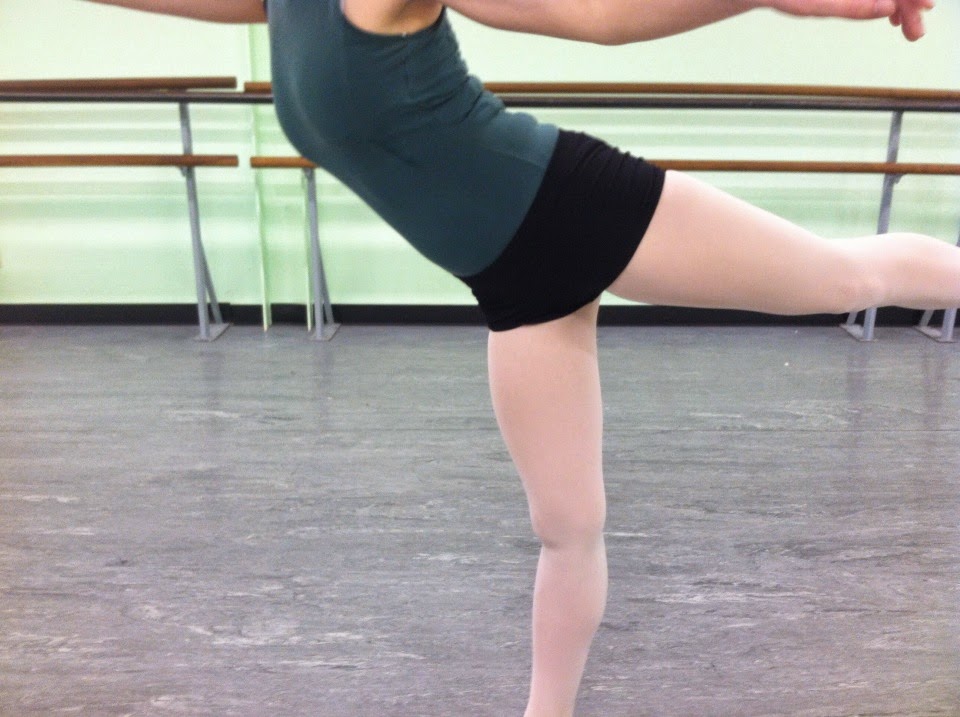
DO NOT pitch forward with your shoulders just to get your leg higher.  (see below)

Corey shows us what NOT to do.

DO NOT sink back in your knee and throw the weight to the back of your heel.

DO NOT crunch your hip flexors (iliopsoas). (see below)

Corey shows us a collapsed, crunched hip.

Some things to embrace:

DO lengthen the front of your hip.

DO engage the quads and hamstrings and pull up the knee of your standing leg. (see below)


Corey shows us a cleaner line.
DO stretch the working leg away from your fifth position as if drawing a J in the air.

DO aim your toe toward the back of your head.

DO keep your spine straight.

To help you, here are a couple of little videos of me working with my student, Corey McCullough. The first shows you her starting and stopping a couple of times as I make corrections, and the second is her doing it on her own. Note how the muscles of her right leg (standing leg) are pulled up and her working leg lengthens and stretches away from her fifth position. (Thank you, Corey!)


 The above video is me giving direction to Corey.


The above video is Corey doing the arabesque on her own.

Happy dancing~

Saturday, September 26, 2009

Pet peeves in ballet class

As a teacher, these are a few of my least favorite things to see:

--Heels lifting off the floor during demi-plie at the barre. Keep them down, down, down! Not only do you shorten your Achilles tendon by keeping them lifted but you also will develop a bad habit that you will take with you to the center. You can't get height or build strength if you do not put your heels down.

--Toes lifting off the floor during rond de jambe and tendu. Tendu means "stretch" and you're not stretching if you allow the toes to come off the floor. Instead, point the toes and feel the legs lengthen all the way to the top of the thigh. By consciously feeling the floor with the baby toe, you will distribute the weight properly which will result in better positioning for releves and pirouettes.

--Hands flinging during allonge. To allonge means to draw out, stretch, lengthen the line. In particular, when we talk about the allonge line for an arm, we mean to rotate the arm up and back, away from the shoulder. Allonge does not simply take place in the wrists and hands. Start with the shoulder lifting up and back and then lengthen the arm away from it, back and up on the ecarte line, all the way to the hands.

--First arabesque arm that reaches higher than the head. The hand should be directly in line with the nose, no higher, and the arm straight at the elbow (unless you are doing Cecchetti in which the arm is often slightly bent at the elbow). But no matter what style you are studying, do NOT lift that arm above your head. It's an affectation that has repercussions through the rest of your body, destroying the line.

Next time I'll talk about things I do like seeing from students!

Happy dancing~