Showing posts with label pique. Show all posts

Thursday, June 28, 2018

Stackables!

It sounds like a new snack, doesn't it?

Have some Stackables with your Lunchables!

Actually, I'm talking about creating a stackable alignment in your body as a way to "get over your leg."

When I talk to my beginner students, especially, about pique and releve, I often tell them they need to get over their legs. In other words, they need to get their torso over their hips and pull up so they can fully point their legs and feet and arrive at the highest releve possible. We never want to sink back into our knees or try to turn or balance on a low releve.

But for many dancers, it's hard to imagine how they get to that place. They end up leaving their hips and derrieres behind them and they never get the highest peak possible.

So add one more "stacking" item as you push yourself to arrive on your leg: your knee.

Think about getting your knee over the center part of your foot and your hips over your knee, stacking one on top of the other.
Courtesy Dance.Net
The above is en pointe, but the same holds true for working in demi-pointe. You will add one more item to the stack: your heel.

So in flat slippers, the stack is: HIPS over KNEE over HEEL over MIDDLE TOES.


When you feel the moment of arrival on the high releve, it feels like you're floating! You can balance forever (or at least it feels that way).

Hope this helps! Happy dancing~

Thursday, January 18, 2018

Starry starry lines: Don't be a star(fish)

No, you're not a mermaid or a character from SpongeBob SquarePants, but you might be a starfish.

You should NOT be a starfish, no matter how cute they are.

Why? Because, unlike the crab (see previous post), a starfish does NOT have a firm center nor does it have any "lines" we would like to see in ballet.

Source: Wikipedia
 As an instructor, I see what I call The Starfish in 2 specific places:

1. Pique arabesque. This usually happens with new students who don't get all the way over their support leg and don't keep their back leg turned out and directly behind them. They throw themselves over their pique leg and fling both arms out to the sides in an attempt to balance. But what they forget is that the pique arabesque is not a pose but a movement. Balance is not static: you must continue to stretch your arms in opposition (or in whatever position the arms have been choreographed by the teacher) to your leg, which is constantly lifting and extending behind you.
Source: Ballet North, dancer - Kristin Smith


2. Grand jete developpe (or saut de chat). This often occurs when the hips are not facing en diagonale. Many new students throw themselves into a jete with the lead leg en avant (in front of) but the back leg in sort of a "seco-baseque"- not quite a la seconde, not quite arabesque. The hips end up sort of front too. The arms are tossed wildly in the air as if the dancer were throwing confetti at a parade as a means of lifting herself off the ground. Again, going back to the basics of the arabesque: extend the front and back legs directly from the center of the body with the back leg turned out. The arms should be reaching forward (typically) and not just up. The hips should be square to the corner of the room in the direction you're traveling.

Source: WikiHow

Ballet is all about lines and shapes. Be very clear and cognizant of the shapes you're creating, especially as you're traveling across the floor. Happy dancing~

Thursday, October 5, 2017

Javelin your pique!

Yes, that's correct. I just used "javelin" as a verb!

Jessica Ennis, British track & field superstar
One of my biggest pet peeves as a ballet instructor is when students bend their knees as they pique to either a turn or a balance and no amount of my shouting, "Keep your knee straight!" seems to help.

Pique is a difficult concept to grasp. In our daily lives we always bend our knees when we walk or run or climb stairs, and certainly in ballet class, we are admonished to bend our knees during plies at the barre or when we jump in the center. But in order to pique properly, we need to keep our entire leg straight and to engage our hamstrings and quadriceps.

Let's use an example with pique arabesque. Here are the basics:

1. With your right leg in tendu devant (knee straight!), prepare with a fondu on the left leg.
2. Push off the left leg and arrive en releve with the right leg completely straight (toes pointed as the foot hits the floor; don't anticipate the releve by flexing the toes).
3. Pull up on the right side of the body so your torso doesn't pitch forward but remains upright.
4. Point the left foot and send the leg up into a long arabesque.
5. Finish with a failli through first position en releve and bend the right leg as the left leg swings through to tendu derriere croise.

Okay, that's simple enough. Except many, many dancers insist on bending the knee in step 2 and end up "climbing the stairs" to their balance en releve. How can we avoid this?

Let's go back to the javelin. I'm sure all of you can picture how a javelin thrower launches her javelin. She heaves it over her head and it arcs up through the air, landing with one end sticking straight into the ground.

In the example above, your right leg is the javelin and your left leg is Jessica Ennis. Launch your javelin in an arc so it goes up and out before landing in the ground. This will mean you place your toe (the sharp end of the javelin) into the ground a foot or more ahead of the rest of your body.

Think LAUNCH then ARRIVE. You launch your javelin and then the body arrives behind it.

Hope this helps! Happy dancing~


Friday, March 17, 2017

Retire v. Passe

What are you talking about, Leigh?

When a dancer pulls the foot of her gesture leg up to the knee of her support leg, this can alternately be called retire or passe. The two look exactly the same but are, in fact, quite different.


Huh? What's the difference?

Think of retire as a position while passe is an action. Retire means to withdraw or "draw up." Passe means passing, as if you are passing through something.

Still doesn't mean anything to me. Why do I need to know this?

It's important to understand the difference so you know when to apply each to what you're doing. For instance, in an adagio, you might think of the gesture leg moving through passe as you develop it en avant. In this case, it is an active part of the movement, rather than a static pose. However, if you were performing a pique turn, you would bring the leg up to the position of retire and think of holding it in that position as you pirouette.

Speaking of pirouette...which am I using?

Both. Kind of. Simultaneously. First, regardless of your preparation for your pirouette en dehors, you take a demi-plie and spring up to your releve on the support leg. The gesture leg draws up to retire and you think of this as the shape in which you will be rotating. BUT! During the turn, you need to keep that gesture leg active so while it is in the retire position, it is actually passe in that the knee is continuing to press back (as you "open the door") and maintaining turnout at the top of the thigh. It does indeed "pass through" just before you finish the turn and roll down to your final pose.

 Anything else you want to say on this topic?

Yes! No matter which you word you use, be sure to keep the hip down, avoid sickling the foot of the gesture leg, and pull up the quads/kneecaps/hamstrings of the support leg. And one more thing...

...happy dancing~


Friday, November 4, 2016

Week's end roundup: Halloween pics, Nutcracker shirts and a Technique Tip!

'Tis the holiday season! First up, Halloween! 

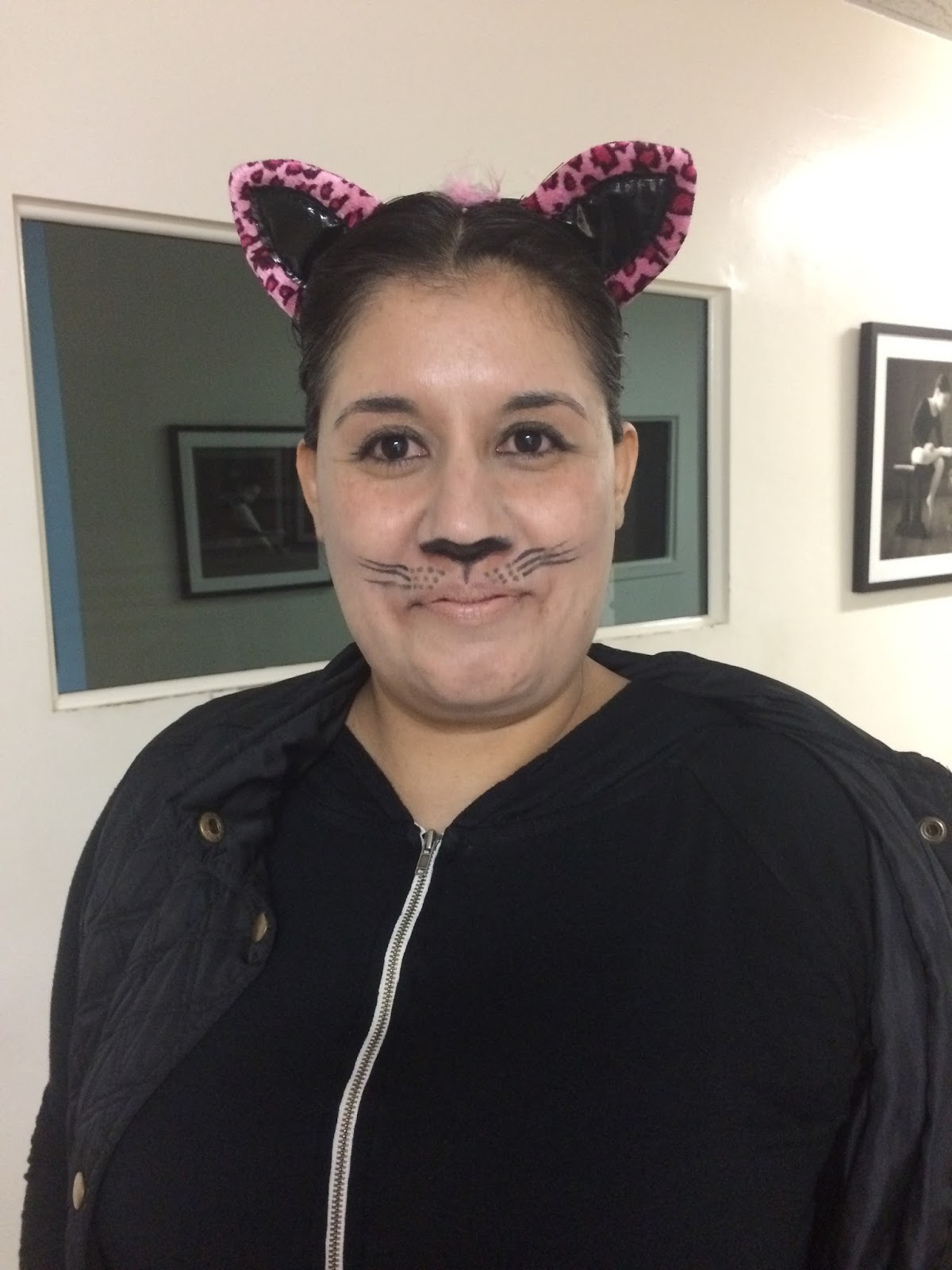
If you didn't make it to class, I hope you spent it trick-or-treating with the kids or being a good neighbor and handing out treats. Here are a few photos of what you might have missed on Monday night:

First of all, chocolate cookies shaped like cats!
Thanks, Martha Stewart!
Students in both classes dressed in costume!


My musical playlist!

And me, as Rosie the Riveter!

And in one month, we'll be performing Nutcracker!

Here is Bill Reiss's awesome design for the shirt to commemorate our Dec 4th shows at the Norris Theater in Palos Verdes, with Classical Ballet Theatre:

Want one for yourself? You can order in black or white, men's, women's and youth sizes here.

And finally, a technique tip to end your week: Get dirty!

That's right - don't be afraid to get your tights dirty (or your socks or your legs) when you:

--hold your leg in retire. Be sure to press the toe right into the knee and lock it in there. If you keep your toe separate from your knee, and it sort of hovers next to the leg instead, you end up hiking the hip instead of maintaining the natural turnout.
--perform pique turns in passe. Again, press the toe into the back of the knee and hold it there for a split second longer than you think. Don't be in a rush to get the foot back down to the ground.
--practice battu at the barre. You want to return the foot to the ankle each and every time you do frappe, rather than let it hover an inch or two above it. And in petit battements, keep the working foot that is in coup de pied very close to the support leg. Try not to circle front to back but instead, form a V-shaped action in the air.
--do rond de jambe en l'air in center or at barre. Your toe will quickly dab at the inner knee when you do this correctly. If you don't actually touch the support knee, that means you are circling the knee improperly, more like a can-can dancer, and that is physically bad for your knee joint.

When you do all of the above, you might end up with pink tights spotted with dirt from your shoes and that's okay. You might even end up with some light bruising if you're wearing pointe shoes or dance sneakers. That's less okay but not unusual! Just be sure to actually make contact when you're performing the above exercises or else you will be hiking your hip and engaging your quadriceps too much.

Happy dancing~


Friday, April 24, 2015

2 more technique videos - Pique and Saute!

A few years ago I shot a number of technique videos, many of which you have probably seen since they were on the blog a while ago. But I still had two more that my ninja webmaster didn't edit: pique and saute.

In the first, I demonstrate a degage pique so students can see how the toes hit the floor and the knee stays very straight. This is something you can practice at home.


In the second, I break down a saute in first position, from demi-plie through releve and saute. You can also do this at home; it's a very good strengthening exercise for dancers working flat and en pointe.


These are the final videos in this series called Fit Ballet with Leigh. From now on, any videos I do will be under the name, Leigh Purtill Ballet. (Same Leigh Purtill, just a bit older I suppose!)

NB: For those of you interested in the pirouette workshops, the Beginner on 4/30 has sold out. If you missed this one, you have 2 options:
1. If you are very new to turns, you can contact me to be placed on a list for a possible second Beginner workshop in late May or June.
2. If you have some experience and know the basics of turning, you can take the Advanced workshop on 5/14 and work on single turns.

Happy dancing~